Schrodinger's Tiger
Current Drafts:
I read Martel, Y. (2002) - Life of Pi again recently. I've been on something of a rereading kick as I've moved through the #burnout process. Rediscovering the books that made me - childhood shapers like Pullman, P. () - His Dark Materials and Gaarder, J. () - Sophie's World, Discoveries of my teens and early 20's like Hopkinson, N. () - Midnight Robber and Allende, I. (1986) - House of The Spirits, and books I failed to read the first time around like Cowan, A. () - Pig.
My greatest and only resource seems to be time. I do not have enough time. Or enough to survive the time. I do not know how long this stretch of empty time will last. Waitlist Time. Haphazard Time. Disorganised Time. Hypermobile Time. Prickly Hypercritical Hyperlexic Time. Swells and storms and stillness and carnivorous algaeic islands.
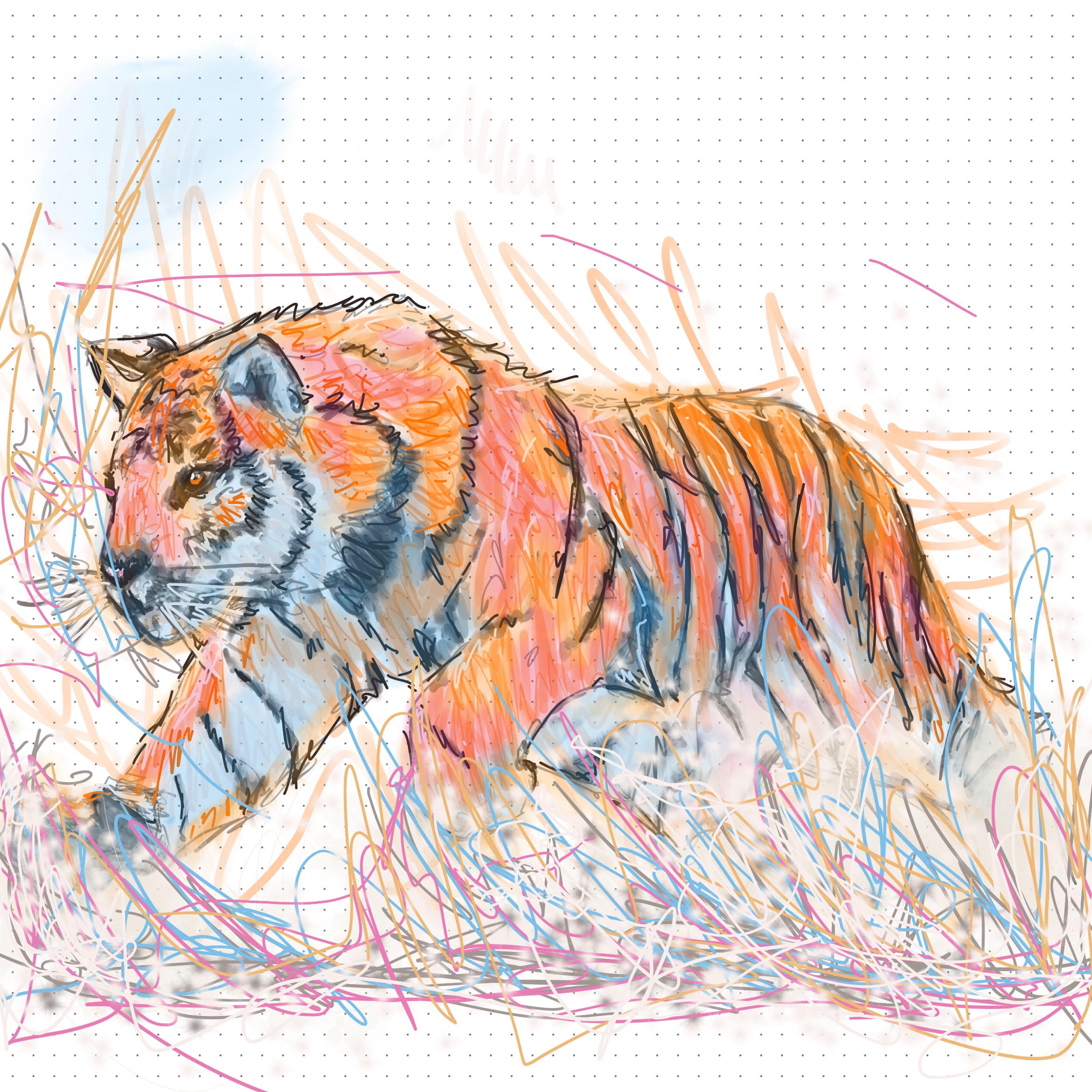
And a lifeboat that may or may not have a tiger in it.
Two quotes from chapter 49 of Martel, Y. (2002) - Life of Pi:
"How I had failed to notice for two and a half days a 450-pound Bengal tiger in a lifeboat twenty-six feet long was a conundrum I would have to try to crack later, when I had more energy."
Richard Parker also explained the animals’ strange behaviour. Now it was clear why the hyena had confined itself to such an absurdly small space behind the zebra and why it had waited so long before killing it. It was fear of the greater beast and fear of touching the greater beast’s food. The strained, temporary peace between Orange Juice and the hyena, and my reprieve, were no doubt due to the same reason: in the face of such a superior predator, all of us were prey, and normal ways of preying were affected. It seemed the presence of a tiger had saved me from a hyena—surely a textbook example of jumping from the frying pan into the fire.[1]
Sjoberg, M. N. (2019) - Reconstructing Truth, Deconstructing ADHD
The ocean, the tiger, the flare up, the pain spike, the dislocation, the getting worse, the depression. There is a tiger in this lifeboat. My survival depends on tending it and I cannot survive without it. I have sailed here before but never in such close proximity.
The matter is difficult to put into words. For fear, real fear, such as shakes you to your foundation, such as you feel when you are brought face to face with your mortal end, nestles in your memory like a gangrene: it seeks to rot everything, even the words with which to speak of it. So you must fight hard to express it. You must fight hard to shine the light of words upon it. Because if you don’t, if your fear becomes a wordless darkness that you avoid, perhaps even manage to forget, you open yourself to further attacks of fear because you never truly fought the opponent who defeated you. [2]
I am afraid of the pain. I am afraid of the dysregulation. I am afraid of the immobility of the flare up and the clumsiness of the fog. I am afraid of the stairs. My body has become a threat. I can tiptoe around it, walk gently and softly on the eggshells, buy it presents, nourish and sustain it. But something always gives. There goes writing, there goes reading, there goes movement, there goes the outside world, there goes the emotional regulation and the decision making.
Pi's approach to Richard Parker, the Tiger in the lifeboat with him, is to tame him.
To dominate him like a trainer in the ring with lions. To shout and sway the boat and blow incessantly on the whistle until the tiger associates Pi's displeasure and infringements on his territory with sickness and unbearable noise.
To tend to him - feed him, water him, keep him alive. Be indispensable to the tiger.
For survival, the sweet and odd and gentle and spiritual vegetarian child sacrifices a rat, beats a fish to death and becomes an adept at killing. Pi dons the double mask of the Bigger Cat and the Zookeeper.
I do this to myself. To keep myself safe from the temperamental tiger of my body. I learned how to do this young, from the others in the lifeboat, the orang-utan and the zebra and the hyena. The tiger might not be so fearsome in the wild. Might be content to leave me to my wanderings so long as I keep out of the way. But in the lifeboat. You need more of a plan. On Planning
Plan Number Six: Wage a War of Attrition. All I had to do was let the unforgiving laws of nature run their course and I would be saved. Waiting for him to waste away and die would require no effort on my part. I had supplies for months to come. What did he have? Just a few dead animals that would soon go bad. What would he eat after that? Better still: where would he get water? He might last for weeks without food, but no animal, however mighty, can do without water for any extended period of time. [3]
This was my first "workable" plan. Leave the tiger to it's own devices, ignore it's growls and antics and hunger and thirst. Focus on waiting out the danger. It's a kind of flight, like Pi's onto the improvised raft. It was good enough for a while to think I could outlast the exhaustion, that my wits might hold me long enough for the aches and jolts and days in bed and nights up sick and sweating to just take care of themselves. That keeping going, using the supplies I had scrounged, would keep the tiger from eating me. That the flimsy life raft was enough to keep me safe.
Darling, it's all a performance, it's all of it playing pretend.
A thought rang in my mind like an angry shout: “You fool and idiot! You dimwit! You brainless baboon! Plan Number Six is the worst plan of all! Richard Parker is afraid of the sea right now. It was nearly his grave. But crazed with thirst and hunger he will surmount his fear, and he will do whatever is necessary to appease his need. He will turn this moat into a bridge. He will swim as far as he has to, to catch the drifting raft and the food upon it. As for water, have you forgotten that tigers from the Sundarbans are known to drink saline water? Do you really think you can outlast his kidneys? I tell you, if you wage a war of attrition, you will lose it! You will die! IS THAT CLEAR?” Ch. 55
There is only so much you can ignore. I was trained well in ignoring my brainbody. There is something self-obsessive in the effort to ignore yourself. Joint-pain-nervous-system-moving-wrong-shouldn't-hurt hypervigilance - bracing against. I saw a rheumatologist who diagnosed fibromyalgia. I was so tense in that appointment nothing would move. I attended a free joint pain exercise programme and the rehabilitation specialist kept pointing to things my hips and elbows and knees were doing that didn't quite add up to the expected. As a child I was prone to fainting spells, this continued into adulthood. I fainted in a school choir performance after standing too long in a hot and crowded room. I fainted in the classroom after standing up too fast. In my partners mum's kitchen. At the bus stop after work. At home after forgetting to eat. At a writing event I'm helping out at I stand up too fast and keel over, partially dislocating my knee with a resounding crunch. I walk home on it, despite offers of a cab. I faint on the stairs. I'm asked by someone at the next one, where I read and mock a poem I wrote when I was 15, after joking about the knee incident, if I have HEDS. I say no, it was a one off. My chunky blocky heels I wear because I cannot walk in anything thinner wear on one side into a diagonal line long before my knee ever subluxes. My wrist is ultrasounded, but after my fibromyalgia diagnosis so it doesn't change anything. The imaging consultant moves my wrists around painfully, says there is years worth of damage there, I hear the word sublux again. I ask about it. I get no answer, I leave. I've already got my answer. I act on the answer. I act as if there is a hyena, and a zebra, and an orang-utan behaving strangely in my lifeboat. And there are. They're all in here and behaving strangely. The tiger is in here too.
I faint again, having pushed myself too far in my inability to articulate the help I need, the help that someone is specifically there to give, the steps involved in what I am doing. I do it all myself and drop things, I drop a tin of beans on my toe. I'd already pushed myself too far to get the bathroom and oven and multi-cooker clean. I have an appointment the following day. I put my shoes on at my desk. I feel dizzy. I stand up. I wake up on the floor, my head spinning, my face pressed into the monitor arms I haven't set up yet because I have yet to buy the second monitor that it needs to function. I also suspect my current monitor of not being the kind that can be attached to the arms. I am in a cold sweat, which I forget to mention to a single medical professional I see after waking my partner up and getting a taxi to A&E. I get too caught up in trying to explain that pain is difficult for me to explain - that I live with chronic pain, and it has affected my already limited ability to interpret how much something hurts in all of the noise. My toe hurt, but not enough in comparison with my hips, or my back, or my knees, or my ankle from avoiding putting pressure on the toe. My face hurt, my lens had popped out of my glasses on one side. I popped it back in before getting up. My toe turned out to be fine. I couldn't put shoes on for a week, it ached for weeks, it still jolts with pain sometimes when I walk. My body has felt such a prison. I have tried to love it. I joke about it to friends. I do not tell my family.
I am in the minor injuries waiting room opposite a young man and his colleague, he has heatstroke from working in some kind of construction in the heatwave. Him and his colleague discuss his return to work. There is a forced enthusiasm laced with fatigue underneath his declaration that he really wants to get back as soon as possible. I want to encourage him not to rush, to learn from me that health is precious and precarious and not to waste his youth on work. I hear the lyric "if you take advice from a man in his early 30's, it's best not to listen unless you want bad advice" [4] I eat half of my sandwich, he goes to throw up. I apologise and stow the other half. He seemed to need it, perked up a bit afterwards I tell myself. I know from experience that sometimes ones body just needs to react to what it's being put through. Whatever it is that it is being put through by whatever is throughing the put. I am sorry for adding "hot sandwich smell" to the list of things through which his body was being put.
I tell my partner to head home so they have plenty of time before their course starts. I have an EEG, lying down, it is normal. I do not suggest we try again with me standing. I am distracted by the discomfort of the person administering it, by my sweat and the oddness of my skin and my sprouting hair and my breasts. I was told to go to the green corridor after my EEG, so I go to the green corridor and the bathroom. I ask someone if I am in the right place, saying "I was told to go to the green corridor after my EEG." They tell me I am in the right place. I get a phone call asking me where I am. I say I am in the green corridor and they ask me to come back to majors. I have been sent to ambulatory majors because my toe does not adequately explain my fainting. I tried to explain that the fainting is not anomalous - it happens when I stand and my body is in distress in some way. It is sometimes the only signal my body can send me through the fog and pain that something needs more than the usual setting aside and breathing and flower. I make sure to tell them no NSAIDS and no opioids because I do not want to throw up. Last time I was here I acquired an anecdote about perfectly predicting the timing and perfectly filling the provided dish. I do not know how long I was unconscious. I think it cannot have been long, because it usually isn't.
I wait in triage in majors, but after asking the triager about having already been assessed they say someone will come get me to go for my EEG. I am at this point alone. An older couple comes in, asks where they need to be and are told to wait. They have a tote bag on the hospital wheelchair, with what looks like a packed lunch and some magazines. They chat comfortably. Quietly.
I am called through. The EEG. The sticky things have trouble sticking to my skin. It is boiling hot in ambulatory majors. It was boiling last time I was here. I had a UTI that coincided with the weekend in such a way as to progress to a full blown kidney infection before I could see anyone about it. The perfectly executed vomit episode, perfectly filling the mushed cardboard of the disposable kidney shaped bowl with the consequences of forgetting to tell them no opioids please, no NSAIDs.
I take every second alone waiting for the EEG to lie flat with my knees up and breathe through the heat and the sweat. I leave for the green corridor when the sticky things are removed. I have been able to get myself around (ambulatory) with my walking frame, but my ankle aches from keeping my weight off my toe and it's beginning to connect my spine to my hips to my knee. I am taken to my x-ray. My foot is x-rayed flat, then I am given a plastic apron and instructed to lie and hold my toes out of the way. I struggle to lie down, my arm feels awkward in it's socket in that position, painfully so. My other toes feel wrenched. The problematic toe protests at the stretching away of its sisters. I grit my teeth. I feel dizzy and sick. A brief discussion floats over my head - it's not broken and appears to be in it's socket. I start to put the pieces together as I stand - it had been out of place, and putting my boots on and standing put it back in place, which made me faint. I remember waking up on the floor of Dragon Hall 9 years or so ago in a similar state. Being found on the stairs that night by my partner and waking the same. I had been putting my boots on this time to walk myself to the first in person therapy appointment I'd booked in a year. Before I go to wake my partner I text my therapist my apologies and add the sharpness of guilt to the list of sensations occupying my brainbodymindself.
A relative commented recently, in response to my referencing a previous visit where I was really struggling with the stairs and so on, that they thought I was fine, or I seemed so. I think now that part of my exhaustion following returning from visits is that performance of fineness. I am hyperaware - hypervigilant - of my expressions of pain. Not making a fuss. Doing what I should do. Hiding how disabled I am. Getting on with it. Willing, despite Convinced it is unhideable. Willing, despite:
Martel describes the movement of fear - the internal struggles and weapons against fear:
One moment you are feeling calm, self-possessed, happy. Then fear, disguised in the garb of mild-mannered doubt, slips into your mind like a spy. Doubt meets disbelief and disbelief tries to push it out. But disbelief is a poorly armed foot soldier. Doubt does away with it with little trouble. You become anxious. Reason comes to do battle for you. You are reassured. Reason is fully equipped with the latest weapons technology. But, to your amazement, despite superior tactics and a number of undeniable victories, reason is laid low. You feel yourself weakening, wavering. Your anxiety becomes dread. [5]
I prickle. I stamp my feet. I seethe-roil. I throw the rat at the tiger and flee. I listen as it crunches and tears and gnaws.
I write in my journal:
STRESS STRESS STRESS STRESS
SHAME ANGER STRESS STRESS
OVERWHELM OVERWHELM OVERWHELM
THE TIGER IS THE FLARE-UP IT'S THE ANGER IN MY JOINTS MY STOMACH MY RIBS MY OESOPHAGOUS RETCHED RAW CAN'T DRINK THE WATER IT MAKES ME SICK CAN'T SEE MY FRIENDS IT MAKES ME SICK CAN'T FEED PEOPLE IT MAKES ME SICK CAN'T GO OUTSIDE IT MAKES ME SICK CAN'T VISIT FAMILY IT MAKES ME SICK CAN'T ASK FOR HELP IF I CAN'T GET BETTER CAN'T GET BETTER WITHOUT HELP CAN'T ASK FOR HELP IT MAKES ME SICK SO I ASK FOR THINGS TO ATTACH TO THE RAFT SO I CAN GET AWAY FROM THE TIGER FOR A LITTLE WHILE OR CATCH AND KILL FISH TO REMIND IT THAT I AM WORTH MORE TO IT ALIVE.
I cannot cut the rope tethering me to the lifeboat. My position is precarious but it is a position. My little raft over here is breaking down. I read the waterlogged guides to survival at sea. One tells me recovery is a kind of faith:
Combining acceptance and hope enabled me to resolve the dilemma of how to have a goal that was both realistic and positive. My approach was based on a kind of faith, the belief that my body had an innate drive to reestablish good health.
I thought I had two roles in support of my body: 1) to discover what conditions best supported my body’s recuperative powers, and 2) to live consistently in a way that allowed these powers to be expressed. I call this faith because I had to proceed with little or no reinforcement that I was doing the right thing. My progress was very slow, at best perhaps one or two percent a month and there were periods of several months when it was hard to see any improvement at all. [6]
In another - essay You Might Not Recover from Burnout. Ever, Devon Price writes:
I want to share that burnout is a seismic shift in a person’s priorities, one that the body enacts by force as a self-preservation tactic — and that some people are so transformed by the experience they can never piece their old life back together. But what’s most difficult (and most delicate) to tell Hea is that all of this might be a good thing. In many ways, burnout is an attempt by the body to give us our freedom back — but it can only do so by taking away our ability to be exploited. [7]
In yet another, Anthea Lawson asks of activists:
What are we entangled in? We are entangled in the ==stories ==that our culture tells about heroes and saviours, and hard work, and the value of doing over being. We are entangled in the oppressive effects of systems of power upon us, whether we have suffered from them or benefited from them or both, and whether or not we can perceive that there are other more generative forms of power that are based in partnership rather than dominance. We are entangled in the habits and ways of being that are normalised in a culture where truly feeling – our own pain, and that of human and non- human others – is numbed and discouraged. [8]
I return to this draft from the flare-up, symptoms still symptoming.
Martel (2002) ch. 49 ↩︎
Martel (2002) ch.56 ↩︎
Martel (2002) ch.56 ↩︎
Friends In Real Life - "Advice" ↩︎
Martel, Y. (2002) - Life of Pi chapter 56 ↩︎
Campbell, B. Recovery from Chronic Fatigue Syndrome https://recoveryfromcfs.org/ch05/ ↩︎
Price, D () - 'You Might Not Recover From Burnout, Ever' You Might Not Recover from Burnout. Ever https://devonprice.medium.com/you-might-not-recover-from-burnout-ever-decc72804552 ↩︎